Some links in this article are affiliate links: we may earn a commission at no cost to you, and it never changes which deals we list. How we check deals
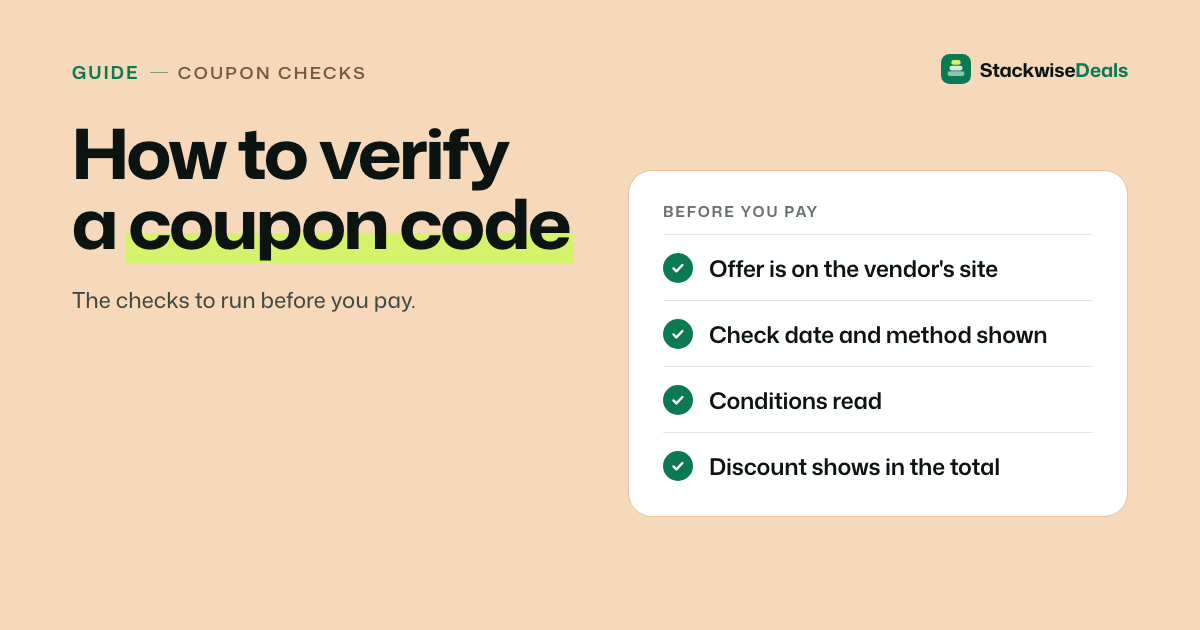
To verify coupon codes, find the offer on the vendor's own site, check when and how each code was last checked, read the conditions and compare it with the vendor's own discounts. Don't pay until the discount shows in the order total. On 29 October 2026 StackwiseDeals has just launched and none of its deals has been checked yet: every one shows the date we added it.
How do you verify coupon codes before checkout?
- Find the offer on the vendor's own site. Many software companies publish their only discount on the pricing page, usually yearly billing, and some say outright that they don't do codes. Ahrefs' pricing FAQ says "We never run discounts", so a page offering an Ahrefs coupon is wrong. Our Ahrefs deal page lists the yearly saving instead. If the code isn't on the vendor's site, ask its support or sales chat whether it is live.
- Look for a date and a method. A label that says a code works, with no date, tells you nothing. You want to know when the code was last checked and how: applied at a checkout, confirmed by the vendor, or a deal link opened.
- Read the conditions. New customers only, first payment only, yearly plans only, one plan, one country. A code can be real and still not apply to you. Some vendors price by region, so a dollar saving quoted elsewhere may not match your checkout. Mangools' pricing data (archived 27 October 2026) puts Basic at $61 a month; some regions see $30.50.
- Compare it with the vendor's own discount. A code is only a deal if it beats what the vendor already offers. beehiiv's Lite plan at 1,000 subscribers costs $708 a year paid monthly and $588 paid yearly (its pricing page as archived on 19 October 2026). Our beehiiv deal page lists ETT, 20% off for three months. beehiiv doesn't publish it, so it fails step 1, and we haven't checked it. Even if it works, it's worth $35.40 on monthly billing (20% of $59, three times). For anyone staying a year, yearly billing saves more than three times as much.
- Try it at checkout, before you pay. Paste the code and check the order summary for a discount line, the total, the billing period and the renewal price. If the discount doesn't show before payment, don't pay expecting it to appear later.
Why don't coupon codes work?
The usual causes are dull:
- The offer ended and the listing wasn't updated.
- The conditions don't fit: wrong plan, wrong billing period, existing customer, wrong country.
- It was single-use, or works once per account and you've used it.
- It's a trial, not a discount. Semrush has no coupon. What "Semrush coupon" pages usually offer is a longer free trial through a partner link, 14 days against Semrush's standard 7. Our Semrush deal page and Semrush coupon vs free trial explain both.
- It never worked. A code can be published without anyone trying it: the brand name plus a number, a generic SAVE20, or a code copied from another list. Only a dated check tells you.
Are coupon sites legit?
Some are, and the good ones show their working. Trust the ones that have all five of these.
- a date on each deal saying when it was last checked, and what kind of check it was;
- a page that explains the site's verification process in plain words;
- a clear statement that it earns commission, if it does;
- expired codes removed or clearly marked, not left in the list;
- a way to report a code that failed.
Warning signs: every code marked as working today, success percentages with no explanation, and countdown timers on offers that never seem to end.
Earning commission doesn't make a site dishonest. StackwiseDeals may earn a commission if you buy through our links, and says so on every deal page.
What checks will a StackwiseDeals deal get?
One of three, and no deal has had one yet: on 29 October 2026 every deal still shows "Added". The full policy is on how we check deals. A deal will be labelled "Verified" only after one of these checks, and the label will carry the date of that check.
- Tested at checkout will mean we applied the code on the vendor's checkout page and saw the discount appear before payment.
- Confirmed by the vendor will mean the product owner confirmed in writing that the code is live and what it covers.
- Deal link checked, for offers that need no code, will mean we opened the deal link and saw the discounted price.
Here are our check targets by type of deal. No checks have started yet.
| Offer | Target |
|---|---|
| Exclusive and partner-submitted deals | Daily |
| Black Friday deals, 1 November to Cyber Monday | Daily |
| All other deals | Weekly |
If a check fails, the offer will be marked Expired and removed from every listing the same day. Its product page stays online, says plainly that there is no active deal, and lists active deals on similar tools.
Every live deal has a "Report a problem" link. Three reports in a week send a deal to the front of our checking queue.
We count how many times a code is copied and how many people click through to a vendor. We never present those numbers as purchases or successful redemptions.
What does "Added" mean on a deal?
It means we haven't checked that deal yet. StackwiseDeals has just launched, and on 29 October 2026 every deal on the site shows "Added" with the date we listed it, and "Last checked" reads "Not yet". None has been through any of the three checks yet: not at a checkout, not with the vendor, and not by opening the deal link. When a deal is checked, the label will change to show the type of check and its date.
Treat an "Added" deal as a lead, not a promise. Until its first check, the five steps above apply to our listings as much as to anyone else's.
Our blog posts each state the date we read the vendor's own pricing and offer pages. That is a check of the published terms, not of the checkout.
What should you do when a code fails?
Click "Report a problem" on the deal; three reports in a week send it to the front of our checking queue. Then look at the vendor's own ways to save, most of which need no code: yearly billing, nonprofit and student programmes, and seasonal sales. GetResponse, for one, takes 50% off monthly plans for charities and NGOs (see our GetResponse deal page).
Frequently asked questions
Are coupon sites legit?
Some are. Trust the ones that date each check, explain what their labels mean, disclose commission and remove codes that fail.
Why don't coupon codes work?
Usually the offer has ended, the conditions don't fit your purchase, or nobody ever tried the code.
What does a Verified label mean on StackwiseDeals?
That the deal passed one of three checks on the date shown. The code worked at the vendor's checkout, the vendor confirmed it in writing, or the deal link showed the discounted price. No deal carries it yet: on 29 October 2026 every deal shows "Added".
How often will deals on StackwiseDeals be checked?
Our targets are daily for exclusive and partner-submitted deals, daily for Black Friday deals from 1 November to Cyber Monday, and weekly for everything else. On 29 October 2026 no deal has had its first check.
What happens to expired coupon codes?
When a check fails, the offer will be marked Expired and removed from every listing the same day, and its product page will say there is no active deal. No deal has had its first check yet.
Sources (5, checked 29 Oct 2026)
Written by
We research software deals for people who build and market websites. Prices in our articles come from each vendor's own site, and every article says when we checked them.